

Stripping large surfaces, such as aircraft fuselages, presents many challenges. It requires a method that is effective, safe, and flexible to adapt to complex geometries and varied workshop conditions. Gel paint strippers offer an effective solution for Maintenance, Repair, and Overhaul (MRO) operations and airlines.

What is a gel paint stripper?
A gel paint stripper is a thick chemical solution designed to remove paint from aircraft structures. Its gel consistency allows it to adhere perfectly to vertical, curved, or even overhead surfaces without running or dripping.
This key feature ensures prolonged and uniform contact time with the paint, which maximizes efficiency and reduces product waste.
SOCOMORE gel strippers are formulated with benzyl alcohol and are free of methylene chloride, chromates, and phenols.
There are several types of gel strippers:
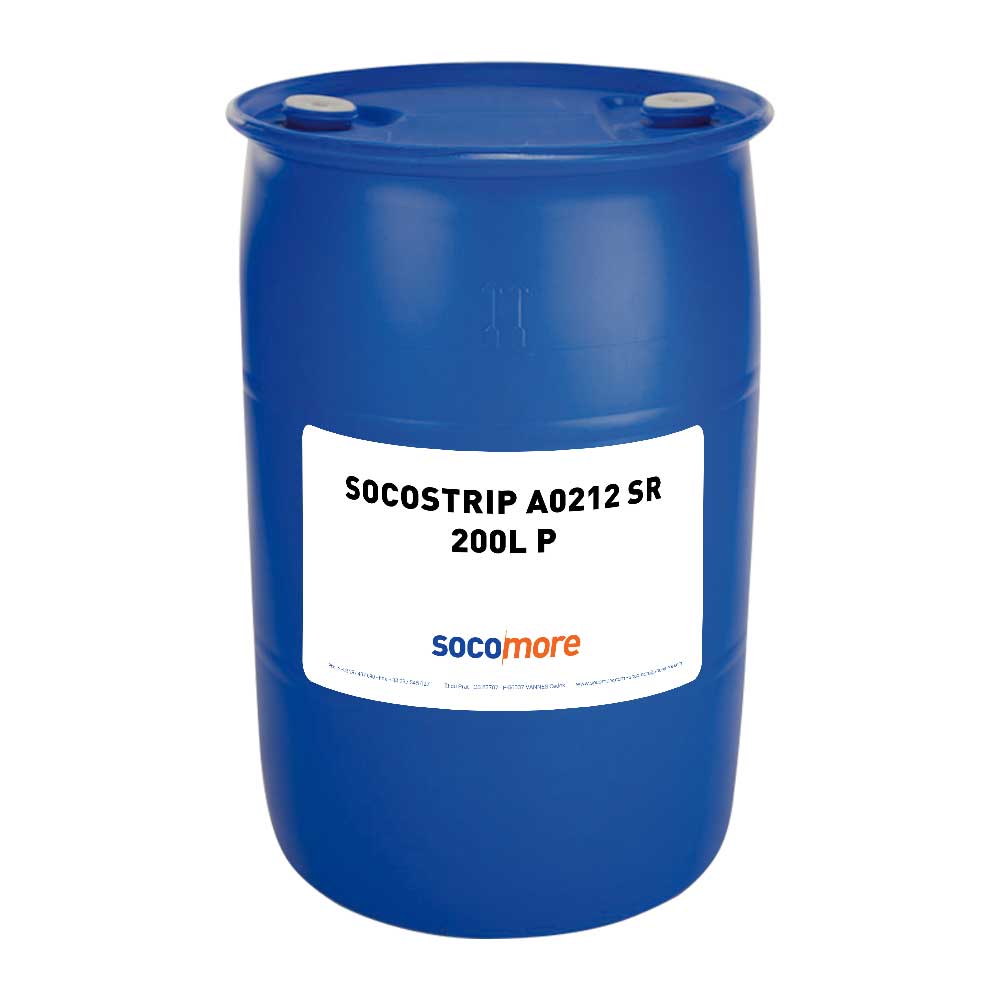
- Acid-activated strippers: SOCOSTRIP A0212 SR
- Hydrogen peroxide-activated strippers: SOCOSTRIP A0103N, SOCOSTRIP A0109N, SPC 909N
- Alkaline-activated strippers: SOCOSTRIP A0102N


What are the advantages of gel strippers?
Choosing a high-performance gel stripper saves money at every stage of the stripping process.
- Flexibility of application:
The gel adheres to all surfaces, making it ideal for the complex structures of aircraft.
- High efficiency and time savings:
A faster stripping reaction allows for earlier scraping. A good stripper can also reduce the number of applications needed and decrease the residual sanding time after chemical stripping.
- Cost reduction:
The product's efficiency means less quantity is needed for the same result, generating direct savings. The low-temperature performance of some ranges also helps to reduce energy consumption related to heating.
- Safety and compliance:
SOCOMORE's ranges are formulated without substances such as phenols, chlorine, or chromates, and comply with REACH regulations.
How to use a gel paint stripper?
Applying a gel stripper is a methodical procedure to ensure an optimal result. The operation's effectiveness depends not only on the product but also on the application conditions and surface preparation.

Step 1: Surface preparation
Before any application, the surface to be stripped must be carefully prepared.
Cleaning and degreasing:
It is essential to start with a pre-cleaning of the surface to remove any dirt, oil, or dust. A clean surface ensures direct and effective contact of the gel with the paint. Products like DIESTONE DLS can be used for this step.
Step 2: Applying the stripping gel
Once the surface is ready, the stripper can be applied.
- Application method: The gel is generally applied using a spray gun. A gel thickness of about 1000µm should be ensured.
- Product adhesion: The gel formula is designed to adhere to surfaces, even vertical or overhead, without running or creating waste.
- Number of coats: Depending on the thickness and resistance of the paint, one to two applications of the stripper are generally sufficient.
Step 3: Contact time and product action
After application, the product must act. The required duration depends on several factors.
- Ambient conditions: The hangar temperature has a direct impact on the reaction speed. A higher temperature (around 30°C) facilitates and accelerates stripping compared to a lower temperature (20°C). Some formulations are particularly effective at lower temperatures.
If you want to know more about this topic, find our dedicated article: Energy and cost-saving in paintshop: Chemical paint stripping at low temperatures
- Paint system: The thickness of the paint (e.g., 80µm versus 300µm) as well as the nature of the layers (type of primer, presence of sol-gel) greatly influence the required contact time.
- Dwell time: The contact time is inherent to the external conditions, the paint, and also the type of stripper used. The dwell time can range from 1 hour to about 12 hours depending on the product, the paint, and the external conditions.
At SOCOMORE, we conducted a test in extreme conditions with a temperature below 20°C.
Discover the results of this test in our comparative video, from the application of the product, to the contact time and the action of the product:
Step 4: Paint removal and finishing
When the paint is blistered and lifted, it can be removed.
- Mechanical removal: The operator can then proceed with the mechanical removal of the softened paint.
- Reduced sanding: Effective chemical stripping leaves less paint residue, which reduces the need and time for final manual sanding.
SOCOSTRIP: A complete and OEM-approved range
Trust is an essential selection criterion for airlines and MRO centers. The SOCOSTRIP range of strippers is approved and qualified by the largest aircraft manufacturers, including Airbus, Boeing, Bombardier, Dassault, and Embraer.
These approvals guarantee that the products have been tested and validated for safe and effective use on different aircraft.
Gel paint strippers are therefore an effective and safe solution for aircraft maintenance. By choosing the appropriate activator technology, operators can optimize their processes and ensure compliance. The SOCOSTRIP range offers adapted solutions.
To discover the gel stripping solution adapted to your fleet and your operations, contact our experts or request a quote.
